
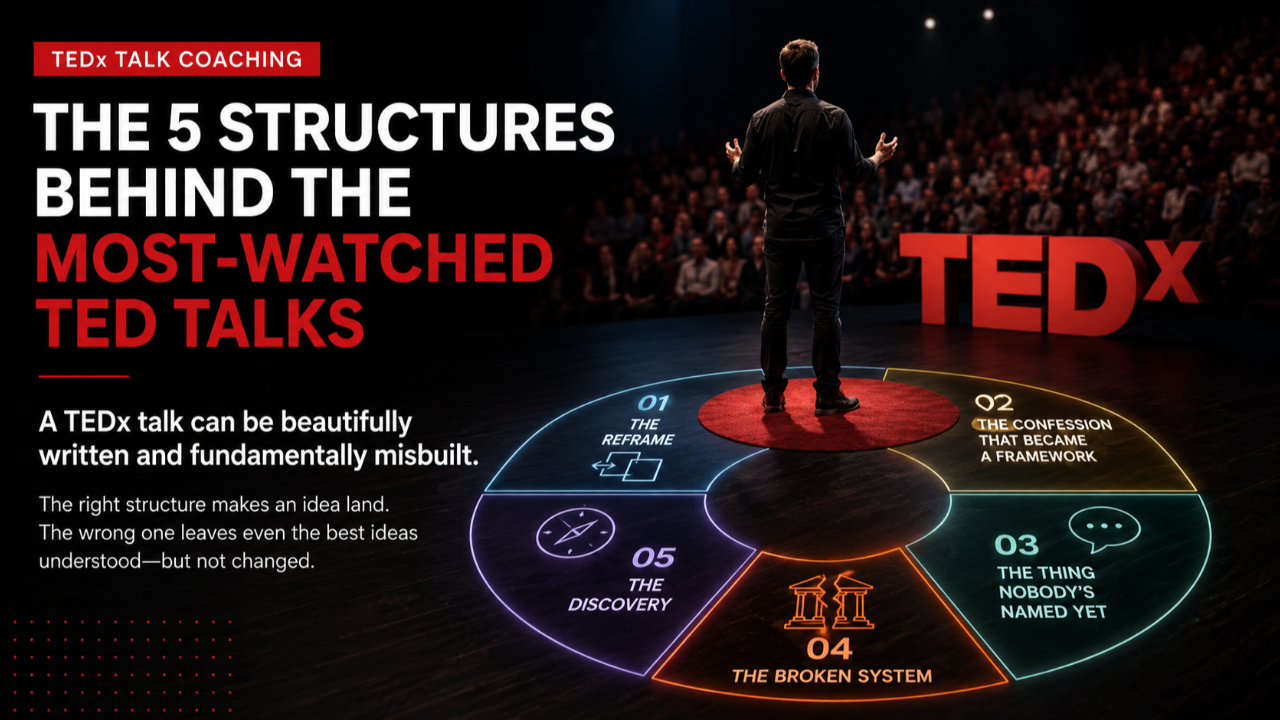
The 5 Structures Behind the Greatest TED Talks
May 14, 2026How to Find the perfect architecture for your TEDx talk:
A TEDx talk can be beautifully written and fundamentally misbuilt.
Most people think writing a TED talk is about finding your story and putting it into a structure. It is not. It is about understanding which kind of idea you actually have — and building the architecture that carries it properly. The structure is not a container you pour your material into. It is the thing that makes the idea land.
The five formats below account for almost every talk that communication researchers, coaches, and speakers return to when they want to understand what a great TED talk actually does. They are distinct. They work differently. And the gap between choosing the right one and the wrong one is the difference between a talk that travels and one that disappears.
Every great TED talk does the same thing: it makes the audience think differently about something they thought they already understood.
What differs is the route. Some reframe what the audience believed. Some name something the audience already lived but had no language for. Some build a case the audience had never seen assembled. Some crack something universal open through a personal reckoning. And some reveal a discovery that nobody — including the speaker — saw coming.
The architecture has to match the route. That is not a creative preference. It is how the idea reaches the room.
The five structures
Know which talk you are actually trying to give.
Read each one carefully. The signal sentences are not hypothetical — they are what people typically say when they are standing inside that type of talk without yet knowing it. The examples are composites drawn from the kinds of coaches, founders, and experts who do this work.
The Reframe
"Most people think X. They're missing Y."
You are dismantling a belief the audience holds comfortably and replacing it with something that makes better sense of their experience. Done well it does not feel like correction. It feels like relief.
A leadership coach who has spent a decade watching companies hire for confidence and lose their best people to it. The talk does not say confidence is bad. It reframes confidence as a symptom — and shows what organisations should have been measuring all along. The audience walks out seeing every hiring decision they have ever made differently.
The Confession That Became a Framework
"I fell apart. Here's what I found in the rubble."
Your personal story does not illustrate the idea — it is the idea. The audience feels seen through your experience, not impressed by it. The confession is what earns the framework.
A therapist who built her entire practice around the concept of boundaries — then had a breakdown because she had none herself. The confession is the collapse. The framework is what she built from it. The audience does not admire her. They recognise themselves. And that recognition is what makes the framework land.
The Thing Nobody's Named Yet
"This has always been happening. Nobody called it that until now."
You are giving language to something the audience has lived but never been able to articulate. The moment of recognition — that is exactly what this is — is the entire talk. It lands like a key turning in a lock.
A career coach who kept watching high-performing women disappear from organisations around midlife — not because they burned out, but because they stopped being seen. She watched it happen for years before she had a name for it. The talk is the name. Every woman in the room recognises the moment she is describing. Several of them cry. All of them share it.
The Broken System
"This isn't working. Here's the proof. Here's what we do instead."
You are showing the scale and cost of a problem without making the audience feel hopeless — then offering a direction that feels genuinely possible, not naively optimistic. The evidence is the thing.
A founder who spent eight years inside corporate wellness programmes watching them fail the people they were designed to help. She collected the numbers. She has the stories. The talk is the case she has been building for a decade — not against wellness, but against the version of it that protects the organisation while leaving the individual exactly where they were.
The Discovery
"I went looking for one thing and found something else entirely."
You are taking the audience on a genuine journey. The destination has to feel surprising but inevitable — as if it could only ever have ended there. The surprise is the whole architecture.
A researcher who set out to study why elite performers quit at their peak. She expected to find burnout, fear, external pressure. What she found was that they were not quitting at all. They were searching for a different kind of winning that the system had no language for. The research did not prove what she set out to prove. That is exactly why it became a talk.
Not sure which structure is yours?
The Build Your Best Talk Yet app will tell you. By the time it asks you about structure, it already knows your idea, your story, your expertise, and how controversial your thinking actually is. It does not just suggest a format — it shows you the reasoning, so you understand why that structure fits your specific material and what the alternative would cost you.
Used as part of our collaboration, the app becomes the map. I bring the human judgement — the thread back to you when the process pulls you somewhere interesting but wrong. The combination is what gets you to the right architecture quickly, rather than discovering six months in that you built the talk on the wrong foundation.
Available as part of the coaching processHow controversial your idea is changes everything.
The same idea built in the wrong way for the wrong audience can feel abrasive when it should feel brave, or obvious when it should feel clear. Before you choose your structure, know where your idea sits on this spectrum. It determines the pacing, the evidence you need, and how early you can afford to show your hand.
The audience is ready to agree.
Your idea confirms something they suspected but could not articulate. The job is clarity — making the implicit explicit, giving language to a felt experience. The risk here is giving a talk that feels good but changes nothing. Comfort without challenge is not an idea worth spreading.
The audience needs to be brought along.
Your idea challenges something, but not so sharply that half the room shuts down. The architecture needs to earn trust before it challenges. Start with what the audience knows is true, then move toward what they have not yet seen. This is where most great talks live.
The audience may resist before they hear you.
Your idea will make part of the room uncomfortable. That discomfort is the point — but it has to be managed with precision. The structure needs to disarm before it provokes. A highly controversial idea in the wrong architecture does not create change. It creates defensiveness.
The questions that locate your talk.
Reading a question is not the same as being asked it by someone who knows what to do with the answer. But here are three to sit with. Notice which one makes you uncomfortable. That is usually the one that matters most.
There are more questions where these came from. The full process — through the app and in collaboration — works through all of them in sequence, building on each answer before moving to the next. That sequence is the work. It cannot be shortcut, but it can be made considerably faster with the right support.
Receive Access to Insider Inspiration:
Stories to motivate, Tips and Course Infos delivered straight to your inbox.
We hate SPAM. We will never sell your information, for any reason.